

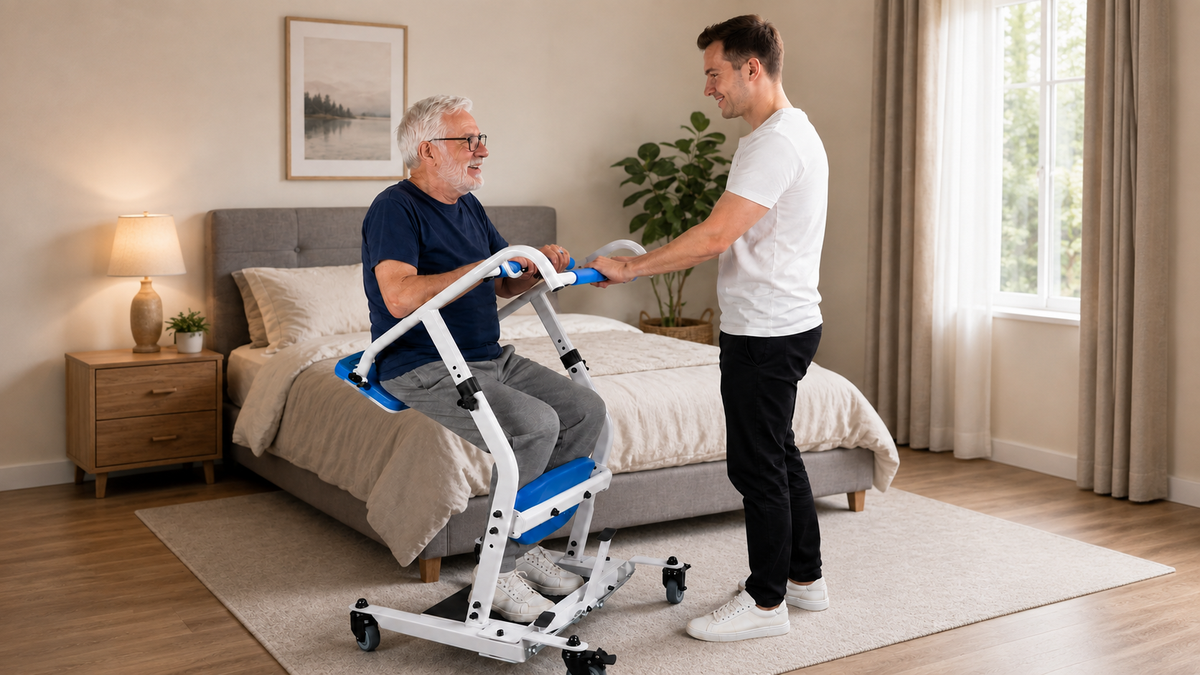
When a parent or loved one begins having trouble standing, everyday movements can become challenging.
Getting out of bed, moving to a wheelchair, using the toilet, or sitting down on the sofa may still be possible—but they may need someone nearby to provide extra support.
For caregivers, helping with these transfers several times a day can also become physically demanding.
If your loved one can still stand with assistance and bear part of their own weight, a sit-to-stand transfer lift can provide additional support for these everyday movements.
WHLICKS offers two options: the more affordable Standard Base and the upgraded Adjustable Open Base.

Which one should you choose? It mainly depends on your loved one's mobility, your home, and where transfers happen each day.
Is a Sit-to-Stand Lift Right for Your Loved One?
A sit-to-stand lift is designed for someone who can still actively participate in standing but needs additional support and stability.
It may be helpful for users who:
-
Can bear part of their body weight
-
Can hold the support bar while standing
-
Need assistance getting up from a bed or chair
-
Feel unsteady during transfers
-
Need help moving between a wheelchair, toilet, bed, or sofa
It is important to remember that a sit-to-stand lift is not a full-body patient lift.
If your loved one cannot bear weight or actively participate in standing, a full-body lift may be a more appropriate option.
Standard Base: Simple, Practical & More Affordable
For many families, transfers happen between the same few places every day.
Bed → Wheelchair → Toilet → Wheelchair → Bed
If this sounds familiar, the Standard Base may provide everything you need.
It offers the essential sit-to-stand functions, including a 400 lb capacity, split support seat, adjustable knee support, 5 height settings, and locking swivel casters.
Because the base has a fixed design, the structure is simpler and the price is more affordable.
It also requires only more than 24" of doorway clearance, making it a practical choice for homes with narrower spaces.
Consider the Standard Base if you want a more affordable solution and most transfers happen around the same furniture.
Adjustable Open Base: More Flexibility Around the Home
Not every chair, wheelchair, sofa, or bed has the same dimensions.
That's where the Adjustable Open Base can make a difference.
The upgraded base can adjust from approximately 26" to 33" wide, allowing the caregiver to change the opening depending on the furniture being approached.
For example, you may need one width when approaching a wheelchair and a wider position when transferring from a sofa or bed.
This makes the Adjustable Open Base especially useful when your loved one moves between several areas of the home throughout the day.
It also features an upgraded reinforced structure while maintaining a 400 lb weight capacity.
Because of the wider base design, this model requires a doorway clearance of more than 27".
Consider the Adjustable Open Base if you regularly transfer between different furniture and want greater flexibility when positioning the lift.
Standard Base vs. Adjustable Open Base
Both models provide the same essential sit-to-stand support, but their base designs and dimensions are different.
| Feature | Standard Base | Adjustable Open Base |
|---|---|---|
| Base Design | Fixed | Adjustable |
| Base Width | Fixed | 26"–33" |
| Doorway Clearance | >24" | >27" |
| Weight Capacity | 400 lbs | 400 lbs |
| Overall Height | 42.5"–46" | 42.9"–46.5" |
| Seat / Platform Height | 22"–22.4" | 20.5"–22.4" |
| Height Settings | 5 Levels | 5 Levels |
| Knee Pad Adjustment | 2 Levels | 2 Levels |
| Armrest / Chest Support Height | — | 30.5"–34" |
| User Height Range | 5'1"–6'6" | 5'1"–6'6" |
| Locking Casters | Yes | Yes |
| Best For | Routine transfers & better value | Different furniture & greater flexibility |
 Which One Should You Choose?
You don't necessarily need the more expensive model.
If your loved one mainly transfers between the same bed, wheelchair, and toilet, and you've confirmed that the fixed base fits your furniture, the Standard Base is a practical and more affordable choice.
If a typical day involves moving between a bed, wheelchair, sofa, toilet, and different chairs, the Adjustable Open Base offers more flexibility. Its 26"–33" opening range makes it easier to adapt the lift to different furniture widths.
A simple way to decide is:
Standard Base → More affordable + compact + ideal for routine transfers
Adjustable Open Base → More flexible + reinforced + better for different furniture
Neither option is automatically better for every family. The right one is the model that works best with your home and daily routine.
Before You Choose, Measure Your Space
Before ordering, take a few minutes to check the places where the lift will actually be used.
Measure your doorways, wheelchair, bed, sofa, and other frequently used furniture.
Remember:
-
Standard Base requires >24" doorway clearance
-
Adjustable Open Base requires >27" doorway clearance
-
Adjustable Open Base adjusts from 26"–33" wide
-
Both models support up to 400 lbs
-
Both are designed for users approximately 5'1"–6'6"
A few simple measurements can help you avoid choosing a lift that doesn't work well with your home.

Making Everyday Transfers a Little Easier
Choosing a transfer lift isn't simply about buying the model with more features.
It's about understanding what your loved one can still do, where they need help, and how transfers happen throughout the day.
For straightforward, consistent transfers, the Standard Base offers the essential support at a more affordable price.
For families who need to move between different furniture and rooms, the Adjustable Open Base provides added flexibility where it matters most.
The goal is simple: choose the level of support that fits your loved one, your caregiver, and your home.
Share:
WHLICKS Sit-to-Stand Lift FAQ: Everything You Need to Know
How to Transfer an Elderly Person Safely at Home: A Caregiver’s Guide