

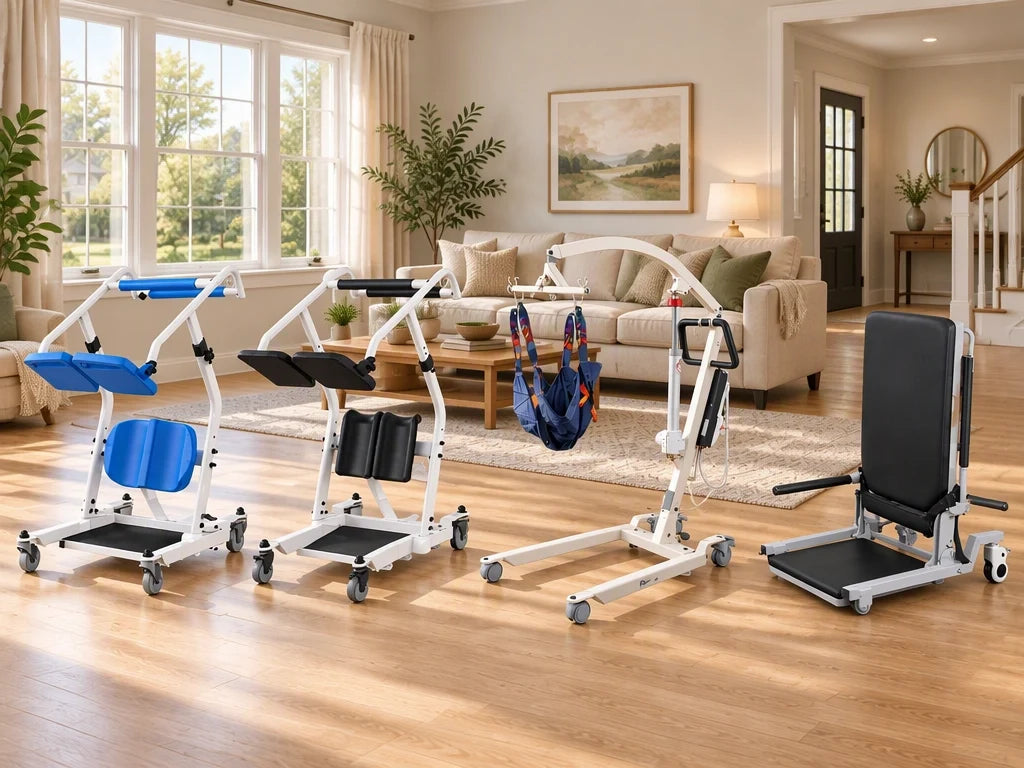
Choosing a home transfer lift for elderly parents starts with a familiar scene: your mom or dad is ready to leave the bedroom, but moving from the bed to a chair takes more planning than it used to. You need equipment that fits the person, the furniture, and the space you actually have.
For adult children helping a parent at home, the question is practical: which design fits this daily routine? This guide compares three WHLICKS options and the measurements to check before ordering.
The Everyday Problem: A Bedroom That Wasn't Planned for Transfers
A nightstand beside the bed, a thick rug, and a wheelchair near the door can leave little working room. Even a roomy bedroom may have a tight entrance or furniture that blocks the equipment's base.
Start by mapping one regular move, such as bed to wheelchair before breakfast. Note the starting position, destination height, clear floor space, and where the caregiver will stand.
For broader preparation, read How to Transfer an Elderly Person Safely at Home. Then return to your room measurements rather than choosing by product name alone.

Three Home-Care Scenarios to Plan Around
1. Moving From the Bed to a Chair Before Breakfast
Your parent starts seated, and the next stop is a wheelchair or nearby chair. Compare the support arrangement, destination height, and room to position both pieces of equipment.
A standing-support aid and a powered lift work differently. Confirm the user's participation requirements instead of assuming either design suits every bed-to-chair transfer.
2. Working Around a Bed and Through a Narrow Doorway
You may have enough room beside the bed but not enough room at the bedroom entrance. Measure both. A base that opens around furniture also needs room when repositioned.
Include the caregiver's working space and the turn outside the doorway. A listed doorway width does not describe the full route through your home.
3. Raising a Seated User From Near Floor Level
A low starting position creates a different equipment question. Compare how the person reaches the support surface and how the equipment raises them afterward.
A floor lift chair raises someone already positioned on its seat. It does not automatically move a person from lying on the floor onto the chair. Equipment planning also does not replace assessment after a fall.

Which Home Transfer Lift for Elderly Parents Fits Your Setup?
WHLICKS Sit-to-Stand Lift: Support Points for Assisted Transfers
The WHLICKS Sit-to-Stand Lift is worth comparing when a parent can partially support themselves while standing. Its design combines padded handrails, shin supports, a split seat, and lockable wheels.
Watch the SAL01S Transfer Aid in Action
For a bedroom-to-chair routine, focus on how those support points line up with the user and how the base approaches the furniture. Adjustable supports serve a different purpose from a motor that raises and lowers a person.
The product page lists a 400 lb capacity, a 5'1"–6'6" user-height range, five height settings, and two leg-pad settings. It offers a Standard Base and an Adjustable Open Base.
Doorway guidance differs by version: the Standard Base is listed for doorways 24 inches or wider, while the Adjustable Open Base is listed for 27 inches or wider. Measure the usable opening and turning space before selecting a style.
For a closer look at selection questions, read How to Choose a Sit-to-Stand Transfer Lift for Home Use. Confirm user fit and required assistance before purchase.

WHLICKS Electric Patient Lift: Powered Lifting Around Furniture
The WHLICKS Electric Patient Lift Transfer Chair offers a powered lifting mechanism with an adjustable base. Compare it when your planned transfer calls for that lifting arrangement, rather than a standing-support seat.
Its base adjusts from approximately 20.9 to 35.5 inches wide. That matters when positioning equipment around a bed or wheelchair: check the floor space, furniture legs, and clearances along the full route.
The page lists a 400 lb capacity, an 8000N motor, an emergency stop, manual lowering, a 360-degree swivel hook, and braked casters. It also lists folding and floor-lifting capability.
Before ordering, confirm the support accessories required for your intended transfer and exactly what comes with the selected product. A swivel hook or powered motor alone does not establish the right support setup for every user.
Plan storage realistically, too. The listed product weight is 88.2 lbs; folding does not make it lightweight. The website describes a two-person carry, so consider whether you need to carry it at all or keep it on one floor.

WHLICKS Electric Floor Lift Chair: Low-to-Seated Height Adjustment
The WHLICKS Electric Floor Lift Chair uses a powered seat to raise and lower a user who is already seated on the chair. It is an option to compare when the planned starting position is close to floor level.
The seat adjusts from approximately 2.4 to 20.2 inches using a two-button wired remote. Compare that upper height with your bed, sofa, or wheelchair rather than assuming every surface will line up.
The product page lists a 330 lb capacity and a 16.53 × 17.71-inch seat. Other features include a reinforced metal frame, padded water-resistant upholstery, a safety belt, rechargeable power, and 4-inch locking swivel casters.
For a family preparing a bedroom, the key question is how the user will be positioned on the chair and moved to the next surface. The lifting range describes seat movement; it does not answer those steps for you.
Check the intended procedure before buying. Water-resistant upholstery also should not be treated as permission to use this powered chair in a shower.
How to Assemble the WHLICKS Electric Floor Lift Chair
Watch this step-by-step video for a closer look at the assembly process. Follow the product manual for complete setup instructions.
Quick Product Comparison
| Option | Physical function | Listed capacity | Check first |
|---|---|---|---|
| Sit-to-Stand Lift | Handrails, leg supports, split seat | 400 lbs | User participation and base version |
| Electric Patient Lift | Powered lifting with adjustable base | 400 lbs | Support accessories and furniture clearance |
| Electric Floor Lift Chair | Powered seat, approximately 2.4–20.2 inches | 330 lbs | Seat access and destination height |
Use this comparison to narrow your questions, not to make a suitability decision based on capacity alone.
Before You Buy: A Five-Minute Home Checklist
- Write down the transfer: starting position, destination, and assistance available.
- Measure the route: doorways, turns, furniture gaps, and clear floor area.
- Compare heights: include the mattress or cushion, not just the furniture frame.
- Check fit and contents: capacity, supports, selected version, and included accessories.
- Plan charging and storage: choose an accessible location without cords crossing the route.
- Read purchase terms: confirm current shipping charges, return conditions, and applicable warranty.
Keep your measurements handy when contacting support. For additional product questions, visit Sit-to-Stand Lift FAQ: Everything You Need to Know.

Keep Daily Use Simple and Follow the Model's Instructions
Clear loose rugs and cords from the working area, keep the floor dry, and make room for the destination chair. Explain the planned movement before beginning.
Follow the specific manual for positioning, supports, brake use, charging, and required assistance. Avoid applying one product's operating sequence to another. If user suitability is uncertain, seek an individual assessment before use.
Choose Your Setup, Then Compare Your Options
The right home transfer lift for elderly parents starts with your family's actual routine. Compare the three designs above, check the linked product pages, and match the measurements to your home.
Ready to take the next step? Choose the product that matches your planned setup, confirm its version and accessories, and review the current purchase details. If questions remain, contact WHLICKS with your measurements before placing an order.

Share:
From Sitting to Walking: How a Foldable Cane With a Standing Assist Handle Fits Into Everyday Life