

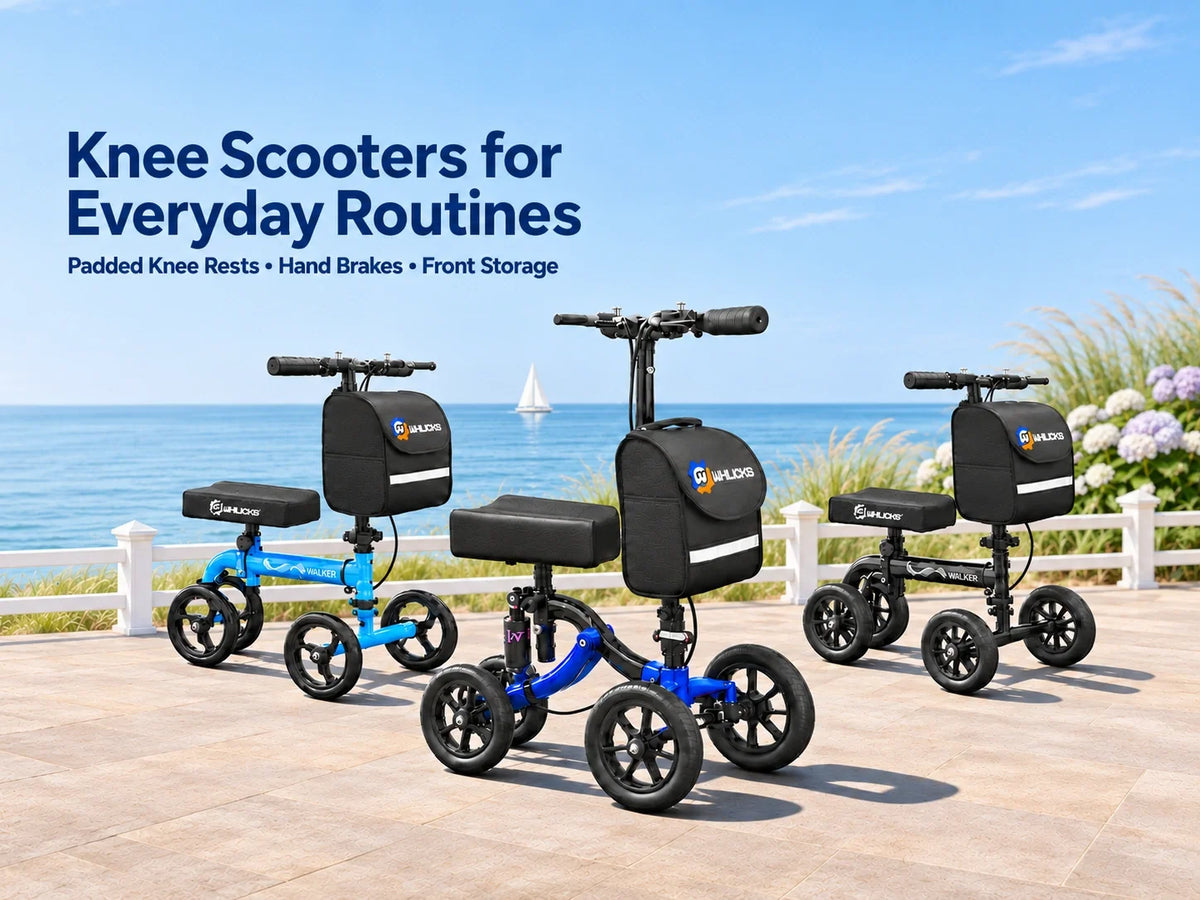
Picture the route you take most often. Is it a tight turn from the hallway into the kitchen? A stretch of sidewalk between the parking lot and your office? Or a trip that starts with lifting a folded scooter into your trunk? Each route makes a different feature matter.
A standard knee scooter is a good starting point if you spend most of your time on smooth surfaces or frequently load it into a car. If your routine includes outdoor paths, an all-terrain knee scooter is worth comparing. Look at the wheel design, overall width, knee pad, and the weight you’ll actually have to lift.

Start With the Route You Use Most
Mostly indoors. Walk through the rooms you use most and look for the tightest spot. It might be the bathroom doorway, the turn around the kitchen island, or a hallway with furniture on both sides. Measure the clear opening with the door in its usual position, then compare it with the scooter’s overall width. A scooter can fit through a doorway and still need more room to turn on the other side.
Indoors and outdoors. Look beyond the distance you’ll travel. The transition from your front door to the sidewalk may matter more than the sidewalk itself. Compare wheel size and material, and check which surfaces the manufacturer lists for the exact model. Use the surfaces you encounter on an ordinary day to guide your choice.
Frequent car trips. Check the scooter’s folded dimensions and item weight. Measure the trunk opening as well as the space inside. If you share the car or regularly carry groceries, check how much room is left with your usual cargo in place.
Knee Scooter Wheel Size: Why Two 8-Inch Models Can Differ
The WHLICKS KS01 and KS03 both list 8-inch wheels, but the KS01 lists rubber wheels, while the KS03 lists polyurethane wheels and is marketed as an all-terrain model. If both are on your shortlist, compare the wheel material and the listed surfaces alongside the wheel diameter. Then use the frame dimensions and storage features to break the tie.
The KS04 gives you a clearer difference in wheel size, with 12-inch front wheels and 10-inch rear wheels. It also weighs 28.2 lb, compared with 20.94 lb for the KS01. That’s a difference of just over 7 lb to consider if you’ll be lifting the scooter in and out of a car regularly.

Compare Three WHLICKS Knee Scooters
| Feature | KS01 Steerable Knee Scooter | KS03 All-Terrain Knee Scooter | KS04 Large-Pad All-Terrain Knee Scooter |
|---|---|---|---|
| What to compare first | Item weight and storage | Wheel material for a mixed indoor and outdoor route | Larger wheels and knee pad |
| Wheel size | 8 in. | 8 in. | 12 in. front / 10 in. rear |
| Listed overall width | 16.54 in. | 16.54 in. | 17.91 in. |
| Knee platform | Padded knee rest | Contoured knee pad | 15-inch knee pad |
| Weight capacity | 300 lb | 300 lb | 300 lb |
| Folding frame | Yes | Yes | Yes |
KS01: A Foldable Knee Scooter for Everyday Trips

Start with the KS01 if you spend most of your time on smooth floors and paved routes or need to pack the scooter into a car often. It weighs 20.94 lb and has a folding frame, a padded knee rest, and a detachable storage bag. If the route through your home includes a tight doorway, start by comparing its 16.54-inch listed width with the clear opening.
View the WHLICKS KS01 Steerable Knee Scooter
KS03: An All-Terrain Knee Scooter for Mixed Daily Routes
Consider the KS03 if your typical day takes you from indoor flooring to outdoor sidewalks. It pairs 8-inch polyurethane wheels with a foldable frame and has the same 16.54-inch listed overall width as the KS01. If you’re deciding between the two, check how much of your regular route is outdoors and review the KS03’s listed surface guidance.
View the WHLICKS KS03 All-Terrain Knee Scooter
KS04: Larger Wheels and a 15-Inch Knee Pad
The KS04 is the one to compare if larger wheels and a larger knee pad are high on your list. It has 12-inch front wheels, 10-inch rear wheels, and a 15-inch knee pad. At 17.91 inches wide and 28.2 lb, it’s worth measuring your narrowest doorway and checking how much you’re comfortable lifting before ordering.
KS04 Knee Scooter Assembly Guide
A Quick Fit Check Before You Order
- Measure your tightest doorway and turn. Compare the clear opening with the scooter’s overall width, then check the space available on both sides of the doorway.
- Check the knee pad and handlebar adjustments. Look for the adjustment ranges and available settings for the exact model. Check each measurement separately.
- Measure your trunk opening. Compare its width and height with the scooter’s folded dimensions, then check the space inside.
- Compare item weight and weight capacity. Item weight tells you what you’ll lift into the car. Weight capacity tells you the manufacturer’s listed limit for the scooter.
Frequently Asked Questions
Can you use an all-terrain knee scooter indoors?
Some all-terrain knee scooters can be used indoors. For home use, check the overall width and the room you have to turn. In this lineup, the KS03 and KS01 both list an overall width of 16.54 inches, while the KS04 lists 17.91 inches.
Are bigger wheels always better on a knee scooter?
Bigger wheels are worth considering if outdoor surfaces are a regular part of your route. For tight indoor turns or frequent loading into a car, give just as much attention to the frame dimensions, folded size, and item weight. Wheel diameter is one part of that comparison.
Will a foldable knee scooter fit in my car?
That depends on the scooter’s folded dimensions and your vehicle’s trunk opening. Measure the narrowest part of the opening, then measure the space available inside with your usual cargo in place. If the listing shows only assembled dimensions, ask for the folded measurements before ordering.
If you’d like to review setup and operation before choosing a model, see our guide to using a knee scooter.
Share:
Rollator Walker for Tall Adults: Handle Height, Seat Height & Fit